The Sampling Gallery
Interactive Monte Carlo, MCMC, and related sampling algorithms.
Build intuition by watching samplers at work
Markov chain Monte Carlo is a powerful tool for simulating from probability distributions — in particular posterior distributions for Bayesian inference. MCMC algorithms have good theoretical properties and are easily utilised in modern software packages. However, on paper each MCMC algorithm is only a few lines of mathematics; its behaviour is not always obvious. This collection of visualisations across a range of target geometries will let you watch a sampler explore a landscape in real time — where it proposes, what it rejects, how gradients, trajectories and adaptation shape the search. Pick a target, choose an algorithm, tune its parameters and watch it run.
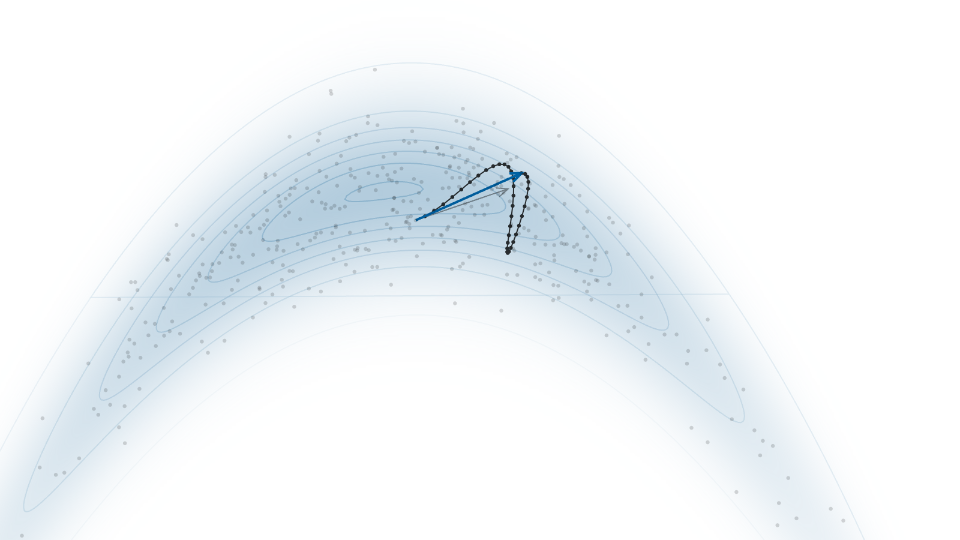
Independent Monte Carlo
Independent draws — exact, weighted or low-discrepancy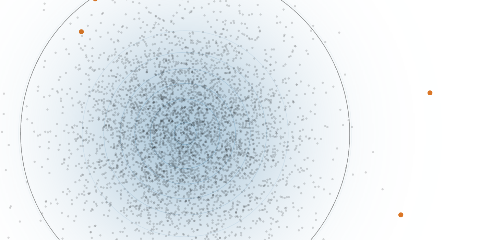
Draws from a simple proposal under an envelope and keeps the lucky ones — exact samples, and a lesson in why MCMC is needed.
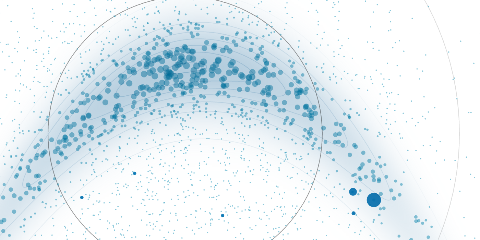
Keeps every draw, weighted by p/q; weight degeneracy and the effective sample size are the whole story. SIR resampling and Pareto smoothing (PSIS) as toggles.
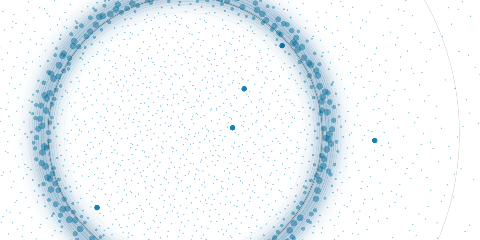
Low-discrepancy point sets instead of random draws — evenly stratified space-filling, side by side with plain Monte Carlo.
Markov chain Monte Carlo
From random walks to gradient-guided chains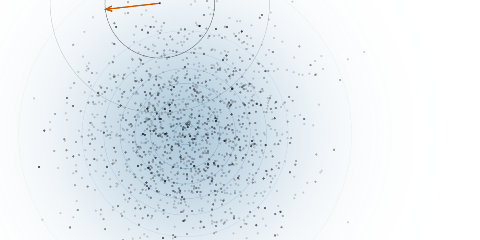
Blind Gaussian hops, accepted by the density ratio — the simplest sampler there is.
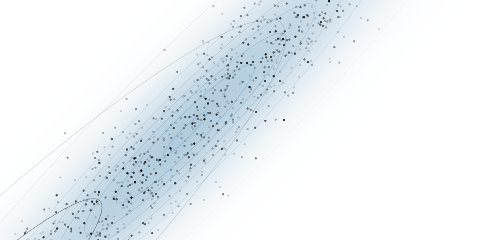
Learns the proposal covariance from its own history as it runs.
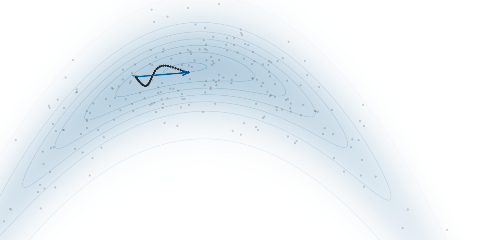
Rolls a frictionless particle along gradients to take long, informed leaps; step-size adaptation optional.
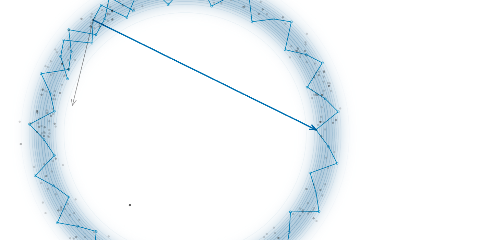
HMC that picks its own path length and step size — the self-tuning sampler behind Stan.

Hamiltonian dynamics on a position-dependent metric that adapts to local curvature — it glides through the funnel's neck where fixed-metric HMC stalls.
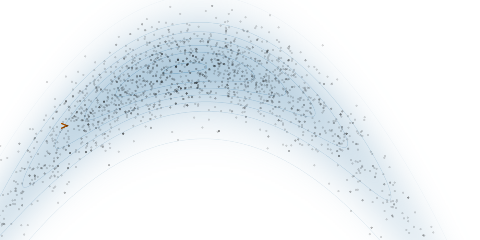
Cuts the leapfrog path into segments at its apogees and proposes from a random window of them — a simpler, tuning-robust alternative to NUTS.
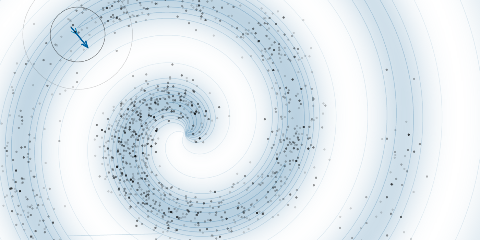
Nudges proposals uphill along the gradient, then corrects to stay exact.
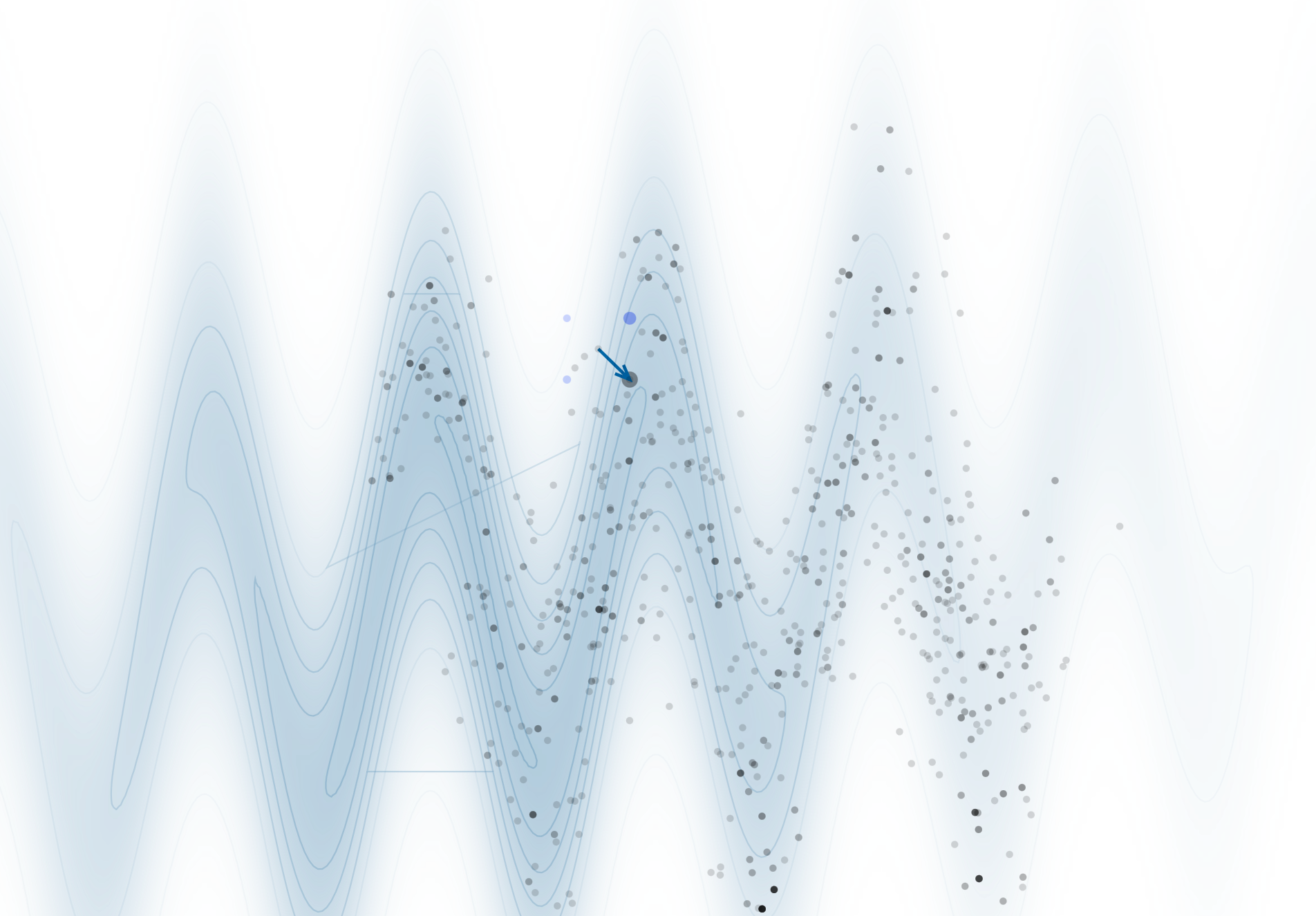
The gradient steers each coordinate's direction rather than its distance — robust to step-size misspecification where MALA is fragile.
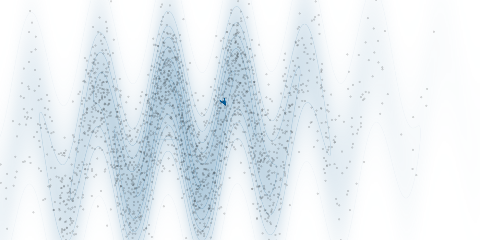
Samples uniformly under the density curve by stepping out an interval and shrinking it — no tuning-sensitive accept/reject step.
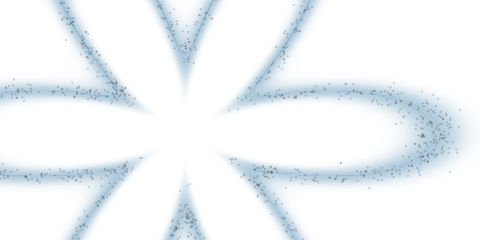
Slice-samples the angle around an ellipse through the current state and a Gaussian prior draw — rejection-free with no step size to tune.
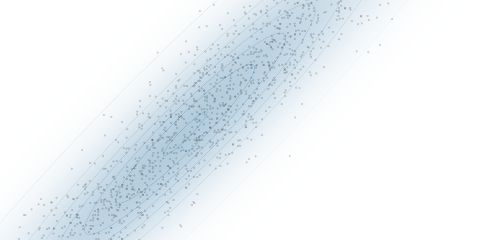
Updates one coordinate at a time from its exact conditional.
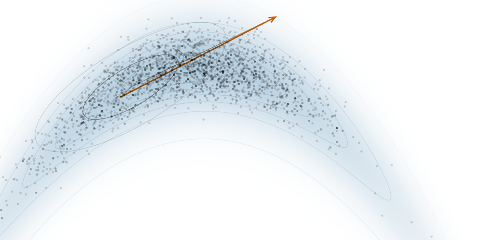
Uses curvature as well as gradient to shape anisotropic proposals.
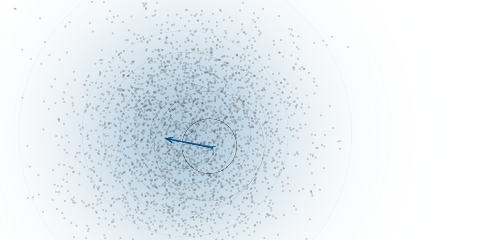
Gradient plus noise, never rejecting — fast but slightly biased.
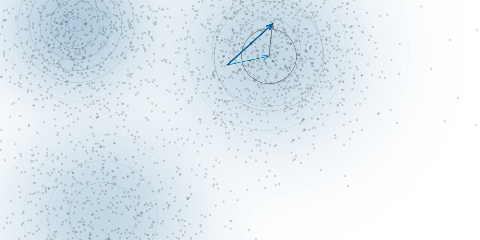
Langevin steps from noisy mini-batch gradients; toggle control variates to tame the noise at the mode.
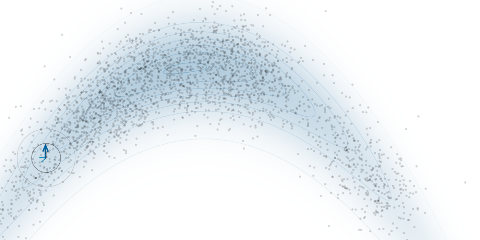
Sets its own step size by optimising over the space of measures.
Ensemble and multimodal methods
Populations of interacting chains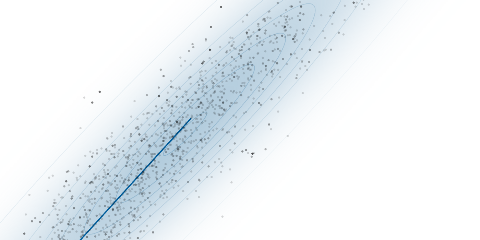
Walkers propose from each other’s positions — stretch moves are affine-invariant, so correlated ridges come for free. Differential evolution as a second mode.
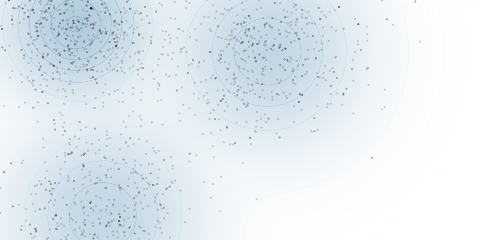
Replicas at rising temperatures swap states — hot chains cross between modes and hand discoveries to the cold one.
Sequential and annealed methods
Through a ladder of easier distributions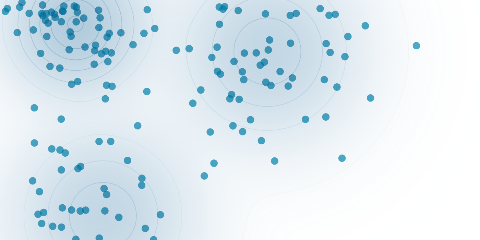
A weighted particle cloud anneals from an easy reference to the target: reweight, resample, rejuvenate. Annealed importance sampling as a no-resampling mode.
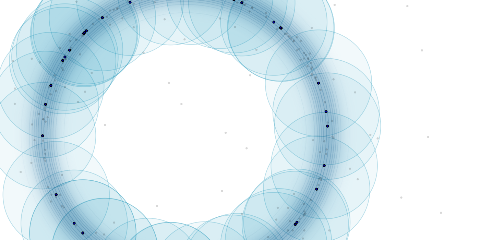
Peels the distribution in shells of increasing likelihood, drawing replacements from a constrained region.
Non-reversible samplers
Piecewise-deterministic, rejection-free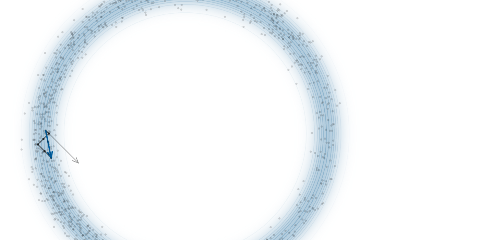
A particle moves in straight lines, flipping one velocity at a time.
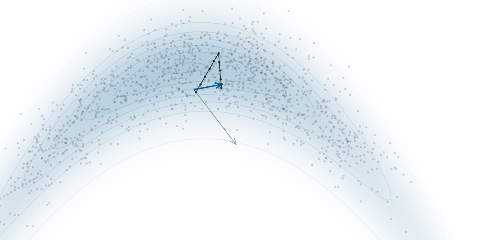
Ballistic motion that reflects off the density’s gradient — no rejections.
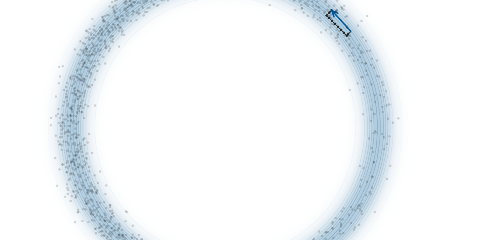
Zig-Zag and Bouncy Particle dynamics driven by noisy gradients, frozen over short windows so event times stay exact — non-reversible sampling for the minibatch era.
Deterministic and variational particle methods
Optimisation in the space of measures
A cloud of particles moves as one, toward the density and apart from itself.
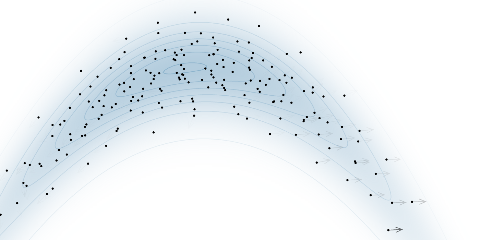
SVGD without a learning rate — every particle coordinate is a coin-betting gambler whose step size emerges from its drift history.
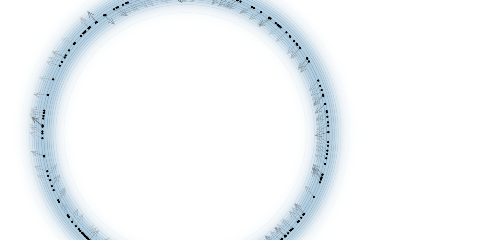
The Wasserstein gradient flow of KL, discretized three ways — Blob, GFSD and GFSF entropy forces — with a live kernel Stein discrepancy readout.
SVGD transport plus Langevin noise — the bridge between deterministic particle flow and stochastic exploration.
References
[1] Haario, Saksman & Tamminen. An adaptive Metropolis algorithm. Bernoulli (2001).
[2] Hoffman & Gelman. The No-U-Turn Sampler. JMLR (2011).
[3] Roberts & Tweedie. Exponential convergence of Langevin distributions. Bernoulli (1996).
[4] Li et al. Anisotropic Gaussian mutations via Hessian-Hamiltonian dynamics. ACM TOG (2015).
[5] Liu et al. Stein Variational Gradient Descent. NeurIPS (2016).
[6] Buchner. A statistical test for Nested Sampling algorithms. Stat. & Comput. (2014).
[7] ter Braak & Vrugt. Differential Evolution Markov Chain with snooker updater. Stat. & Comput. (2008).
[8] Welling & Teh. Bayesian Learning via Stochastic Gradient Langevin Dynamics. ICML (2011).
[9] Baker et al. Control variates for stochastic gradient MCMC. Stat. & Comput. (2019).
[10] Sharrock & Nemeth. Tuning-Free Sampling via Optimization on the Space of Measures. (2025).
[11] Bierkens, Fearnhead & Roberts. The Zig-Zag process. Ann. Statist. (2019).
[12] Bouchard-Côté, Vollmer & Doucet. The Bouncy Particle Sampler. JASA (2018).
[13] Neal. Slice sampling. Ann. Statist. (2003).
[14] von Neumann. Various techniques used in connection with random digits. (1951).
[15] Kahn & Marshall. Methods of reducing sample size in Monte Carlo computations. (1953).
[16] Geyer. Markov chain Monte Carlo maximum likelihood. (1991).
[17] Del Moral, Doucet & Jasra. Sequential Monte Carlo samplers. JRSS-B (2006).
[18] Goodman & Weare. Ensemble samplers with affine invariance. CAMCoS (2010).
[19] Neal. Annealed importance sampling. Stat. & Comput. (2001).
[20] Niederreiter. Random Number Generation and Quasi-Monte Carlo Methods. SIAM (1992).
[21] Vehtari, Simpson, Gelman, Yao & Gabry. Pareto smoothed importance sampling. JMLR (2024).
[22] Murray, Adams & MacKay. Elliptical slice sampling. AISTATS (2010).
[23] Sherlock, Urbas & Ludkin. The apogee to apogee path sampler. J. Comput. Graph. Statist. (2023).
[24] Sharrock & Nemeth. Coin sampling: gradient-based Bayesian inference without learning rates. ICML (2023).
[25] Girolami & Calderhead. Riemann manifold Langevin and Hamiltonian Monte Carlo methods. JRSS B (2011).
[26] Betancourt. A general metric for Riemannian manifold Hamiltonian Monte Carlo. GSI (2013).
[27] Liu, Zhuo, Cheng, Zhang, Zhu & Carin. Understanding and accelerating particle-based variational inference. ICML (2019).
[28] Zhang, Zhang, Carin & Chen. Stochastic particle-optimization sampling and the non-asymptotic convergence theory. AISTATS (2020).
[29] Fearnhead, Grazzi, Nemeth & Roberts. Stochastic gradient piecewise deterministic Monte Carlo samplers. arXiv:2406.19051 (2024).
[30] Livingstone & Zanella. The Barker proposal: combining robustness and efficiency in gradient-based MCMC. JRSS B (2022).